...

domingo, 25 de octubre de 2015

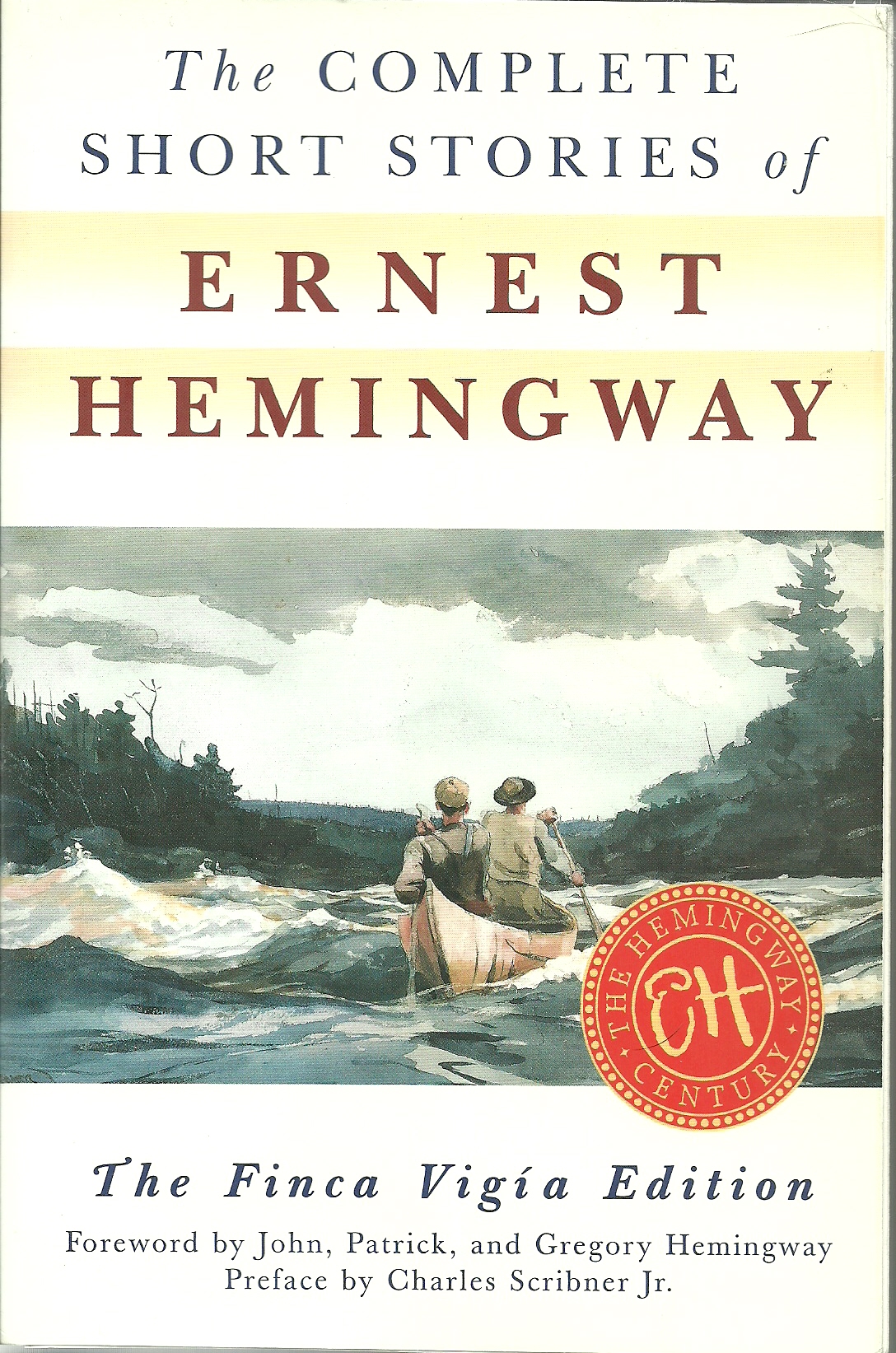
Fathers and Sons - Ernest Hemingway

Rating: 
22/10/15


Once more, like a salmon, swimming against the stream. For this is presented as a fine classic of iceberg theory, and I don't see it that much like in other stories. So don't pay attention to anything I have been saying concerning Ernest Hemingway. Every reading experience is subject to one's personality (my goodness, Florencia, you discovered gunpowder). It is so attached to ourselves, so related to our character, our nature, our psyche, that it is a pointless task to try to decode why we liked a book and why the others did not. I am the one who doesn't dislike a lot of description about the surroundings, but prefers the descriptions about everything that is going on inside the characters' head. Of course, I like knowing where the characters are and what they are doing, but I greatly appreciate when they reveal why they are doing... whatever they chose to do. I mean, I don't need to know why they are grabbing a cup of coffee and walking towards the kitchen; I can read a map. I'm referring to the great choices in their lives.
So, when I met this writer, I was confused. I felt inadequate. My perception was non-existent. I could not connect with him. I saw a distant, indifferent man unwilling to give any detail about the people and the universe he created. After reading a bunch of stories, it hit me. It was simply his style. He didn't believe it was necessary to write about everything because you would be able to understand through the art of the implicit. Easier said than done. Some of us have to work a little to reach the profound meaning of his writings.

For me, for this innocent, limited lamb that is writing to you at this moment, this is one of the most transparent short stories I have read so far. It is about the relationship between Nicholas Adams and his father, told through memories while he is driving with his own son. Role models, betrayal, hunting, awkward scents, punishments, nature.
All sentimental people are betrayed so many times.

These little snippets of his childhood are substantially honest. And beautifully written. A beauty that can put a smile on your face. A beauty that will certainly horrify you. An unsettling beauty to which you can relate. This cold, minimalistic style that so well defines Hemingway became a modest bundle of emotions, restrained, yet waiting for me to unfold them. Ready to allow me to see beneath the surface. To see the parallel between a beautiful landscape and memories that took place in there but sometimes you wish you could forget. We can forget about picking up a friend, buying coffee, a distant relative's birthday. We can deceive ourselves and think we forgot about those significant scars of childhood, the grown-ups world. However, they always find a way to come back no matter how hard we push them back. We can find temporary sanctuaries, like getting lost in the warm arms of nature. Like in most Hemingway's stories.
If he wrote it he could get rid of it. He had gotten rid of many things by writing them. But it was still too early for that.

A breath of fresh air. Some peace for a broken mind. Finally.


Hills like White Elephants - Ernest Hemingway

Rating: 
21/10/15

Hills like White Elephants
A couple. A bar. A health condition of some sort. And a small research done by a reader to understand what was going on, exactly. Mere descriptions of actions and dialogue were not enough. But the reader doesn't blame the author for her lack of perception. A detached author that seems to barely know them.
A foreign in their lands.

Economy of the words. Emotions, all over the place. In silence. They have lost their names yet their presence is still felt.

Something breaks.

"We can have the whole world."
"No, we can't."


martes, 20 de octubre de 2015

The Capital of the World - Ernest Hemingway

Rating: 
18/10/15

No, he would not be afraid. Others, yes. Not he. He knew he would not be afraid. Even if he ever was afraid he knew that he could do it anyway. He had confidence.

Simplicity is the key. I know. A simple plot can become a work of art thanks to great writing. In this ambivalent relationship I am having with Hemingway, the more I read, the more confused I am. So far, I had a similar reaction only towards Cortázar's work.
A new contestant has arrived. However, I have nothing but good news, today. In a parallel universe, this is the Hemingway I would sing Christmas carols with. (Inside joke.)


"The Capital of the World" is a short story about a young man named Paco who lived in Madrid. He worked as a waiter in a hotel called Pension Luarca, where bullfighters usually stayed. They are described as second-rate matadors, since they achieved greatness but because of certain circumstances, their careers were reduced to memories.

Well, Paco's dream was to become a bullfighter. Even though I can't relate to the romanticism he saw in that heinous activity, I do understand the feeling of having a dream that seems bigger than one's existence. And the reactions it might generate.
Paco was surrounded by people leading dull lives without any prospect. On the contrary, he was a cheerful boy full of dreams and ideals, typical of youth. (Typical?) He was waiting for a chance to create the future he was longing for. Unafraid. Overconfident, even. A raw melody tempting tragedy. Something evoking sailors being lured by an irresistible song.

Paco's joy and desires of fulfilling his dreams can't dissipate the melancholic atmosphere of Hemingway's prose. The smothering sense of nostalgia and loss lies in every page of this short story. (Recurrent themes I always enjoy in this sometimes futile search for empathy.) The author offered some character development that gives the story the psychological depth I always look for. I saw a boy full of illusions, ready to prove everybody wrong. Eager to accomplish his lifetime goal. Unwilling to stay in the same place, beholding how other people's lives were fading out, in silence. Until they are nothing more than blurred lines in the air moving mechanically, helping others to fulfill their wishes.
Paco is not the perfect example, though his eagerness to make his dream come true certainly leaves you pondering about where do you want to go. The defeated bullfighters remembering the greatness of bygone days, leave you thinking about where you are now.
Different questions emerge from all the characters of this story. The answers might soothe you. If you are lucky enough.


sábado, 17 de octubre de 2015

The Killers - Ernest Hemingway

Rating: 
03/04/15


There was a great TV show once. A brilliant sitcom known as “the show about nothing”. But even though it was perceived as a show about nothing, it was about nearly everything. Well, “The Killers” is a story about almost nothing. Could I say it is about nearly everything? I don't know, but it is certainly not as entertaining as the aforementioned sitcom. It might be interesting for academics wanting to study words and structures and other fun things. From that hilarious perspective, yes, it caught my attention that, besides the “almost nothing happens” issue, that “almost nothing” is told in the simplest way possible. That is quite coherent, I guess. The writing is simple, straightforward. You are given a bunch of characters that lack all development; you have to settle with only knowing their names. Passivity is this short story's trademark. The somewhat lack of action is something that leaves you wondering about possibilities and limitations, being and nothingness. It is rather unsatisfying. Too many “what ifs” frustrate me.

I just read about the Iceberg Theory. I am certainly not a fan of an extreme minimalist style but I think I can take it on small doses. I do not ask for meaningless details, daily minutiae that no one cares about; but I want something that allows me to connect with the characters. Use your words and give me emotions. Give me thoughts, feelings, doubts, melancholy, some joy. I do not seek obvious revelations nor redundant thoughts. I would reread The Alchemist, in that case. But again, give me something more... If Hemingway used this style on an entire novel, I can see why the whole reading experience can be tiresome. Even Rory G. described him as painful. So, reader, Hemingway fan, let me know what novel I should try first.

Back to the short story. Some characters deal with a situation that in any world would be considered as stressful, and yet, nothing happens. They stay still, unable to move because of some strange force. You cannot think of something else rather than they are already surrendered, they feel doomed and think that any action is futile having in mind the inevitability of life. It is probable that you do not see all this. Maybe this is me trying to find something meaningful. Maybe there is. Okay, I am sure there is; I simply cannot see it... that well. I guess.

Verdict.
Hemingway, regarding short stories, I think we can be friends. However, concerning novels... you are that estranged acquaintance I would send a Christmas card to, but I'm not sure if we are ready to meet and sing Christmas carols together across town.
We need time. And more small doses.


* This review was written on April 3, 2015; I just found it today. I don't remember the story. I don't know why I wrote what I wrote but... there it is.


martes, 29 de septiembre de 2015

The Double - Fyodor Dostoyevsky

Rating: 
30/09/15

Through the bureaucratic ocean of papers, there lies Joseph K., bored with unanswered arguments.
Behind an unapologetic desk, Bartleby sits in silence, preferring nothing.
As a timid door opens, Bashmachkin leaves the smothering atmosphere of the office, ready to meet with the others. All set to forget the tasteless morning coffee and the men trying to make their way through scheme and flattery, and recover the humanity once lost. The sun is setting. A gentle breeze with a scent of independence caresses their faces.
Golyadkin, our protagonist, is waiting for them.

The world of the oppressed rests in Dostoyevsky's prose. The essential analyst of the human nature.


Briefly, The Double is about Mr. Golyadkin and his doppelgänger, Mr. Golyadkin Jr., someone who has been born under a stressful snowstorm.
This novella has many elements that can be found in Gogol's work. His influence on Dostoyevsky is well-known. However, this writer dealt with those same themes with an innovative style that traces clear limits. He even did that with his own work. For me, this was nothing like the novels I have read before. Universal themes like oppression, sorrow, alienation, work and loneliness are always treated from different angles and original ways of execution. Originality perceived by the mind of Sábato: we all are the sum of what we have read. Topics do not change; the way we express ourselves on them, might.

When I read The Brothers Karamazov, my eyes contemplated Dostoyevsky's genius, word by word. My copy is all written. I underlined hundreds of sentences that tried to enlighten the intricate path toward the mind. A humble attempt of understanding. However, the times I underlined something on The Double was for the main purpose of keeping up with the story. Actions. Names. I did not find many memorable reflections that left me at awe. The ones I found were at the beginning, mostly. So, what then? It was all contained in the interpretation. The development of facts, the story itself was what left me staring at an invisible point, drawing in the air, pondering about my own existence and the futility of things.
The fragility of one of the most precious things we own. Our mind. A set of cognitive faculties. A place. A process. Sanity.
His position at that moment was like the position of a man standing over a frightful precipice, when the earth breaks away under him, is rocking, shifting, sways for a last time, and falls, drawing him into the abyss, and meanwhile the unfortunate man has neither the strength nor the firmness of spirit to jump back, to take his eyes from the yawning chasm; the abyss draws him, and he finally leaps into it himself, himself hastening the moment of his own perdition. (39)

We cannot own our mind. Under certain circumstances—sad, nerve wracking, shameful circumstances—, it reacts as it pleases. Or the best way it can. It is the main source of who we are and yet, a trivial fact has the power to break it. A single act. An accumulation of traumatic acts. A life of unfortunate events. A pile of obedient frustrations. The meek silence of unwanted, inevitable solitude. The desire of success in a suffocating environment with people that have already been chosen over you. The search of identity in an alienated world.
Do not be alone too much.

These are just some of the observations that emerge from The Double, a true work of art that portrays a man's psychological struggle, with a brushstroke of unforgiving reality. We are placed inside Golyadkin's head. We are privileged spectators of his mind. We see it work. We see it weep. We see it shocked, unable to move. We shout, because we know what to do (even though we might react the same way if we were in his shoes, you never know).
A privilege that thrills and frightens.
There is much emotion in Dostoyevsky's descriptive and cautious writing. So much, I cannot bear it.


* Note: Months ago, I watched a 2013 film starring Jesse Eisenberg, based on this novella. Artistically exquisite. Keep it in mind!


sábado, 26 de septiembre de 2015

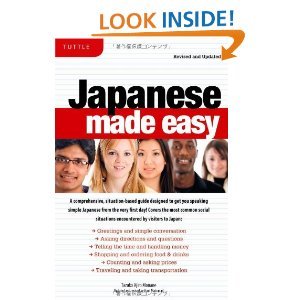
Japanese Made Easy: Revised and Updated - Tazuko Ajiro Monane

Rating: 
25/09/15

はじめまして。フィレンツェ です。よろしくお願いします。 – Introduction.
ありがとう ございます。 – Thank you.
ごめんなさい – Sorry.
すみません、ほんや  どこですか? – Bookshop!
コーヒーをください。– Asking for all drinks and food you can think of.
その 本 をください。 – Asking for that book. I think.
すみません、病院  どこですか? – Hospital, just in case.
。。。 が 食べたい です。– I'd like to eat -
じゃ、行きましょう。It just sounds awesome.
大人、一枚。– Tickets.
これいくらですか? – How much is that?
領事館 は どこ ですか – Where is the Consulate?
警察 – Police
わかりません。– I don't understand.
お勘定 お願いします。– Check, please.

Yeah... That's pretty much all I need. I would bring my books anyway and colorful pictures to point out. We lose all shame when we want people to understand us.

I have learned some sentence patterns (polite Japanese, mostly), quite helpful for a tourist. I repeat, a tourist. So I cannot even imagine what it would be like if I ever started studying the language seriously, like taking real classes and such. Something I will never do because then comes the sense of obligation. When I know that every Monday or Thursday at 4.00 p.m. I have to get out of my house and attend to class or whatever, to learn what I voluntarily decided to learn, I start seeing it as an obligation, a duty. And I lose encouragement. That stage of my life disappeared when school ended. I enjoy being a self-taught kind of person. I like the freedom that it entails. I like reading and learning things while sitting next to a window, with a big bowl of coffee (or a latte, perhaps some cookies or cake...) on the table by the couch, and my slippers ready to assist me when I have the need of revisiting the coffee maker. I dislike schedules and formalism; I enjoy reading at home. The simplicity of home. Of course, it is more difficult, with a major tendency to mistake because I do not have a teacher here (and I would not have one, either). However, I am always willing to take the risk.

So, I read this book, I wrote on three different notebooks—grammar, notes, culture and vocabulary, examples—, I sighed, I cursed, I forgot, I read again, I sighed some more. My brain was briefly replaced by a giant question mark and later came back; exhausted, with a feeble pulse. Oh, alive, nonetheless! Hiragana tends to do that. Counters tend to do that. I understand the need of three scripts (one that I did not even try to study yet), but why couldn't you just count with the same words, most of the objects of this planet? I mean, in Spanish, no matter the physiognomy, we say one elephant, two tickets, eleven balloons, fifty cats. But no, I got lost, drowned in a deep sea of suffixes. A hitotsu-futatsu-mittsu fan, all the way. Do not make me count fifteen little animals or vegetables because I will not survive. And yes, I know, Spanish is not a walk on feathers, either. All languages have endearing quirks. We have our “sheets” and “slices” but nothing too complicated. Unless you add a million verb forms (the unforgiving subjunctive), gender issues, articles, prepositions, pronunciation (the inexorable letter “R”), dialects, false cognates. Oh, nothing major...

There is some sunshine in this strange adventure. I got used to the sounds (such a delicate music can be found in some syllables), the word order—even though I still struggle with some particles because my memory is not that good. Adjectives are a bit tricky also and the complexity of the system of honorifics stole some tears from my eyes so I will just stay at the safe polite-language zone. But I love it. A tortuous passion. It is a dare. A lovely, melodious and captivating dare. A dare that always leave other people wondering why the hell I am doing this. There is no reasonable answer. Or maybe there is. I read some aspects of their fascinating culture, intriguing habits, rich history, numerous social conventions. All things absorbed my interest and led me to that distant language. Okay, maybe there is not a reasonable answer. A simple “why not?”. I am now starting reading about the Italian language (a homey feeling), but I see German quite appealing too. I feel too awkward speaking in French (when I say awkward I mean stupid) but Russian calls my name. So, why not?

Anyway, I spend many hours of the week reading and rereading, pronouncing words and practicing. It is almost therapeutic. Especially in those places where time feels like a turtle running a marathon while wearing a cast. For instance, at the bank. At any doctor's office. At any government office. All those places where you feel like time stands still, where you see people standing up because they have been called, they have been chosen and yet, you are there, longing for someone to call your name and end this tedious, frustrating, mind-numbing waiting. So, yes, reading helps me remaining a somewhat sane person during those motionless situations. And Japanese was and is a beautiful escape.

And this book gave me some tools to make that escape possible. No, it is not that easy. At least, not for a person whose first contact with the language was a rōmaji "Moonlight Densetsu" at age 11 and that was it.
I bet you didn't see that one coming... Oh, don't judge, I was a kid.

This book is a fine introduction to Japanese. It contains many sentence patterns, the usual verb forms that will allow you to sound human, a lot of vocabulary, notes about many aspects of their culture to help you understand more by giving a little context, activities so you will not immediately forget what you just learned, etc. Its structure is predictably convenient: the book is organized according to the complexity of the study material, one that covers many grounds. It is a clear path. The organization, I mean. As you read, the path will bifurcate until you feel like a weary Minotaur in the middle of a paper labyrinth. It is a constant challenge but Saint Google will be there to assist you. You will need other resources. Beware of rōmaji, a dangerous acquaintance. I cannot give it up.

So no, my friend. Do not be afraid. Grab your pencils and mugs, your notebooks and Kleenex, and dive into this sublime ocean of kana characters.
Dō itashimashite.


lunes, 21 de septiembre de 2015

Conversations of Lord Byron: Noted During a Residence with His Lordship at Pisa in the Years 1821 and 1822 - Thomas Medwin

Rating: 
21/09/15

The days belong to Byron.

I had written a review and, later, decided to delete it. Okay, I did not delete it, I just put it in the folder where legends die. Anyway, that review had quotes and facts and some nonsensical analysis of the conversations that Thomas Medwin transcribed, after a logical warning: he could deliver the substance but not the form, that being Byron's wit and eloquence.

I wrote that review and then realized how useless that was. I could say everything I wanted to say in one single quote. A quote by an extraordinary writer. The true enchanter of all words; familiar and unknown.

If, after I die, someone wants to write my biography,
There's nothing simpler.
It has just two dates—the day I was born and the day I died.
Between the two, all the days are mine.

- Fernando Pessoa, A Little Larger Than the Entire Universe: Selected Poems (61)

Between the two, all the days are mine.
Besides its unquestionable beauty, there is a particular sound that cuts the air like the sharpest of knives.
Between the two, all the days are mine.
A sound you can almost feel. There. Practically piercing your body, finding its way to your mind in the most incredible display of self-preservation.
All the days are mine.

All the days are ours.