...

jueves, 12 de noviembre de 2015

Now I Lay Me - Ernest Hemingway

Rating: 
12/11/15

The moonlight was not enough. The nights were made of darkness and fear. A palpable fear, so strong it could have paralyzed the most powerful of men. His nights were not made to rest, anymore. For they were covered with different shades of black. And that soldier knew that if he shut his eyes in the dark, his soul would go out of his body. He was certain of that. So, if there was not some light around, he was going to stay awake. Thinking. Nothing more dangerous than a human being immersed in terror and left alone, thinking. The past stepped in as a haze of blurred images, forgotten names and one regret or two. Prayers were said over and over. And when he could not remember them, he recited every form of living thing he knew. And then cities and streets.
...and when I could not remember anything at all any more I would just listen. And I do not remember a night on which you could not hear things. If I could have a light I was not afraid to sleep, because I knew my soul would only go out of me if it were dark.

Until he found himself in broad daylight, when it was safe to sleep. If the ground was also safe.

In this short story (my last one), Hemingway openly leads the path towards the character's mind, and we are restless witnesses of his struggle and the way he found to deal with his fear. A fear created by war and that was portrayed as the inability to sleep in the dark. The best way the soldier found to keep his soul within him.

As stated above, this is one of the most psychologically deep stories I have read during these past few days. There is not just one line that barely allows you to understand the characters, but... everything. So you can imagine my surprise. Sure, the story is written with Hemingway's renowned minimalistic style, but Iceberg City does not feel so silently cold anymore. In fact—and concerning most of his stories—emotions often disrupt this seemingly descriptive atmosphere with the strength of a loud storm. Through a word, a line, a paragraph. It takes time. The most precious thing we have. But it is there, beneath all triviality, all ordinary descriptions, actions. Beneath every detail that illustrates the surroundings, the contrast between man and nature. And the complement they represent to each other.
A sanctuary, when men and women cannot find their place in the land of humanity.



miércoles, 11 de noviembre de 2015

The Battler - Ernest Hemingway

Rating: 
11/11/15

A walk through a dark forest.
A dark forest that needed a little light.
A little light came from a fire, that way.
That way he chose and over there he walked.
He walked until he saw a man.
A man that gave him some conversation.
Some conversation led to a revelation.
A revelation about his past and his state of mind.
Mind if I talk to you about some tragedy?
Tragedy awaits when you face the world alone.
Alone because she left you.
You, me, can't decide who's talking.
Talking about the mind when reason has left me too.
Too much for this tough man.
Man, it's time for a walk.

"You're all right," he said.
"No, I'm not. I'm crazy. Listen, you ever been crazy?"
"No," Nick said. "How does it get you?"
"I don't know," Ad said. "When you got it you don't know about it.


lunes, 9 de noviembre de 2015

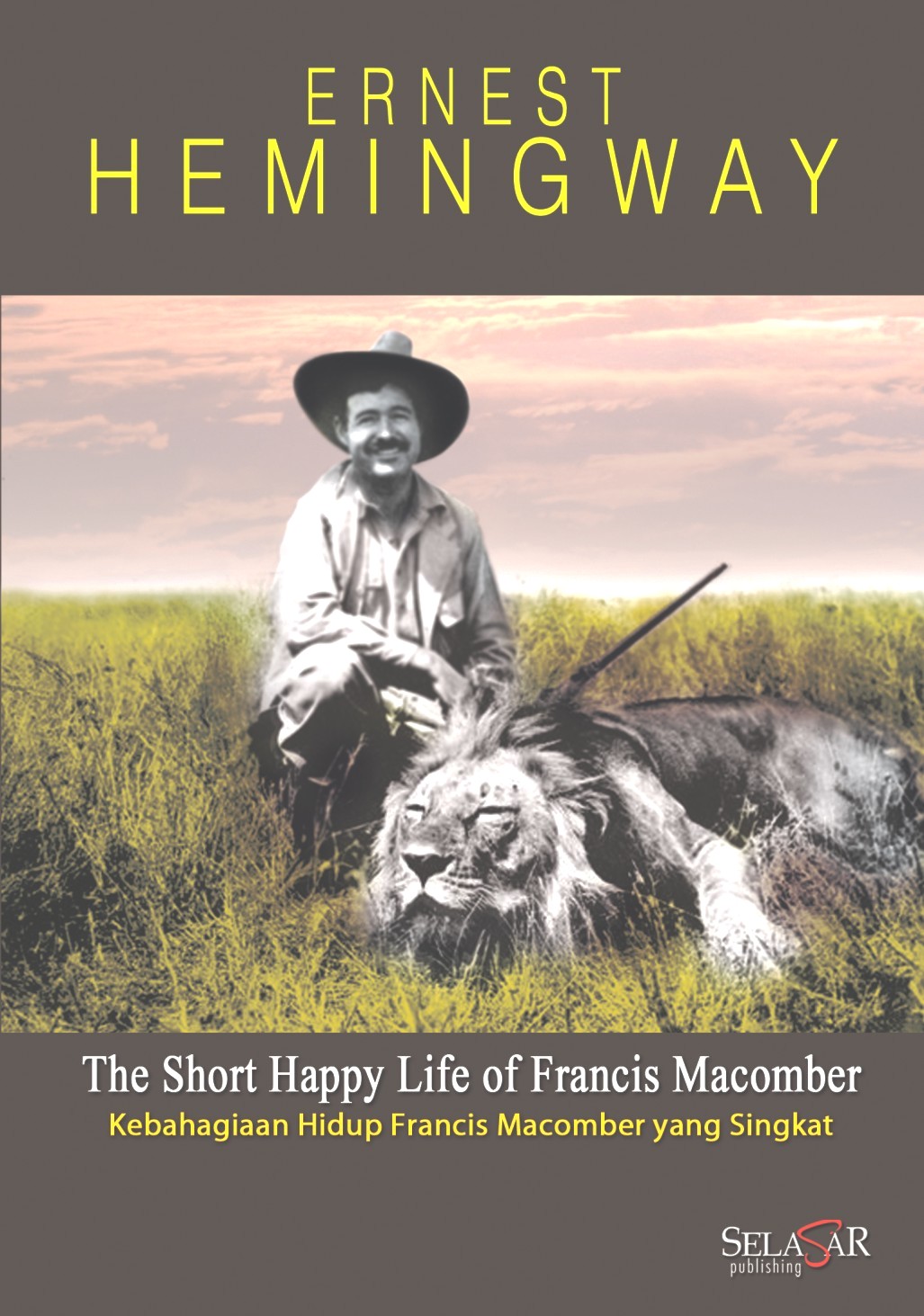
The Short Happy Life of Francis Macomber - Ernest Hemingway

Rating: 
08/11/15

A lion, symbol of courage and a significant connection between a man and his wife. I was not too fond of any of the characters of this story but I have to admit something: I don't remember being so repelled by a female character since Cinderella's stepmother. Well, in the name of debatable maturity, I am pretty sure I felt that with other fictional people but I can't remember at the moment. And now I can't stop thinking about it. I need another female character that I really disliked. Great, this is going to bug me. This is taking a weird turn and now I am writing as my mind dictates. Yeah. This is how babbling is created. Ursula, Maleficent, Evil Queen, Cruella de Vil... I have been possessed by Walt Disney now, stop it. Wait. Disney. Ducks. Daisy. Daisy Buchanan. Done.

This short story started a bit slow and on top of it all, dealing with the barbaric activity of hunting; to kill for the sake of killing. However, as I kept reading, human nature and its inherent conflicts came to surface. Every piece started to fall into the right place—at least, from my humble point of view—and the twist I was warned about before, was a sudden shake that induced the collapse of this initially dull universe. It confirmed all suspicious. (Hemingway deserves patience; I am still trying to adjust.)

This is a story about many things, but it mostly involves the loss of cowardice and control. Hemingway described fear in the most evocative way possible. His minimal amount of words to portray emotions and such vividness between the lines gradually captivated me. What has started tiresome to me became a pulsating prose that revealed a story infused with fear, contempt and the desire of controlling everything. Everyone.
Until the last minute.
Accidentally, voluntarily. Will or chance. I wouldn't know.

A story about the act of breaking ties with manipulation and the rage that such happiness precipitates. All elements that, inevitably, pave the way to the core of tragedy.


domingo, 8 de noviembre de 2015

The Doctor and the Doctor's Wife - Ernest Hemingway

Rating: 
31/10/15

Three stars. An okay short story. A couple of interesting themes that are open to interpretation because, like we all know now, Hemingway reveals as little as possible. But still, I wish he would have developed them a bit more.
I am asking H. to write more, yes, I know how that sounds.
Oh, don't judge, we are not in Salem. But even if we were and some villagers had decided to parade me through town with a crowd recreating the possible last scene of The Stranger, I would be still shouting: three stars!


domingo, 1 de noviembre de 2015

A Clean Well Lighted Place - Ernest Hemingway

Rating: 
01/11/15

What did he fear? It was not a fear or dread, It was a nothing that he knew too well. It was all a nothing and man was a nothing too.

An old man drinking alone. A man that won't leave, a young waiter in a hurry to go home to his wife and another waiter. It is as simple as that. The complexity that left me stunned lies beneath that simple plot that unfolds with the help of Hemingway's characteristic style. And, once more, the economy of words cannot tame the torrent of emotions that can take over even the most distracted of readers.

Every mortal must face loneliness. They do it in their unique ways.

Some people try to divert their attention away from the loud silence of introspection, so they focus on work. Or they turn on the TV. Or run to their wives or husbands, pitying those less fortunate, thinking that they will never feel that kind of despair. Forgetting about the fleeting essence of youth.

Some people pour brandy into a shiny glass, feeling the silence of the night in a clean, well-lighted place. For neither money nor youth are enough to banish despair from a too sentimental soul.

Some people watch. They watch the rest of humanity facing their loneliness and try to provide a clean place with decent light to those in need. They face their loneliness helping other to face theirs, in the best way possible. It gets intense. It is an uncontrollable force that reduces the world to nothing. A man in the vastness of this universe; nothing. A god in the mind of the desperate who cannot feel his presence; nothing. The human being trying to find meaning in the context of human nature's absurdity; nothing.
My first five stars are dedicated to nothingness. To an eternal search. To Hemingway and his detached writing that left me amidst the chaotic silence of my room, contemplating nada.


domingo, 25 de octubre de 2015

Fathers and Sons - Ernest Hemingway

Rating: 
22/10/15


Once more, like a salmon, swimming against the stream. For this is presented as a fine classic of iceberg theory, and I don't see it that much like in other stories. So don't pay attention to anything I have been saying concerning Ernest Hemingway. Every reading experience is subject to one's personality (my goodness, Florencia, you discovered gunpowder). It is so attached to ourselves, so related to our character, our nature, our psyche, that it is a pointless task to try to decode why we liked a book and why the others did not. I am the one who doesn't dislike a lot of description about the surroundings, but prefers the descriptions about everything that is going on inside the characters' head. Of course, I like knowing where the characters are and what they are doing, but I greatly appreciate when they reveal why they are doing... whatever they chose to do. I mean, I don't need to know why they are grabbing a cup of coffee and walking towards the kitchen; I can read a map. I'm referring to the great choices in their lives.
So, when I met this writer, I was confused. I felt inadequate. My perception was non-existent. I could not connect with him. I saw a distant, indifferent man unwilling to give any detail about the people and the universe he created. After reading a bunch of stories, it hit me. It was simply his style. He didn't believe it was necessary to write about everything because you would be able to understand through the art of the implicit. Easier said than done. Some of us have to work a little to reach the profound meaning of his writings.

For me, for this innocent, limited lamb that is writing to you at this moment, this is one of the most transparent short stories I have read so far. It is about the relationship between Nicholas Adams and his father, told through memories while he is driving with his own son. Role models, betrayal, hunting, awkward scents, punishments, nature.
All sentimental people are betrayed so many times.

These little snippets of his childhood are substantially honest. And beautifully written. A beauty that can put a smile on your face. A beauty that will certainly horrify you. An unsettling beauty to which you can relate. This cold, minimalistic style that so well defines Hemingway became a modest bundle of emotions, restrained, yet waiting for me to unfold them. Ready to allow me to see beneath the surface. To see the parallel between a beautiful landscape and memories that took place in there but sometimes you wish you could forget. We can forget about picking up a friend, buying coffee, a distant relative's birthday. We can deceive ourselves and think we forgot about those significant scars of childhood, the grown-ups world. However, they always find a way to come back no matter how hard we push them back. We can find temporary sanctuaries, like getting lost in the warm arms of nature. Like in most Hemingway's stories.
If he wrote it he could get rid of it. He had gotten rid of many things by writing them. But it was still too early for that.

A breath of fresh air. Some peace for a broken mind. Finally.


Hills like White Elephants - Ernest Hemingway

Rating: 
21/10/15

Hills like White Elephants
A couple. A bar. A health condition of some sort. And a small research done by a reader to understand what was going on, exactly. Mere descriptions of actions and dialogue were not enough. But the reader doesn't blame the author for her lack of perception. A detached author that seems to barely know them.
A foreign in their lands.

Economy of the words. Emotions, all over the place. In silence. They have lost their names yet their presence is still felt.

Something breaks.

"We can have the whole world."
"No, we can't."